
The transformer oil sampling procedure is where every oil result is won or lost. Open a valve, fill a bottle, and you hand the lab a snapshot of a sealed tank you’ll probably never open. Get the sampling wrong and it doesn’t matter how good the lab is — no analysis can rescue a bad sample. Everything below exists to protect that one idea.
The method comes from IEC 60475, Method of sampling insulating liquids. It covers both sampling from oil-filled equipment and sampling new oil in drums and tankers.
Table of Contents
The decision that comes first: what test are you sampling for?
Container choice is not a detail you sort out at the truck. It is driven by the test. IEC 60475 sets it out:
| Test | Container | Volume |
|---|---|---|
| Dissolved gases (DGA) | Glass syringe, metal flexible bottle, glass bottle, glass or metal ampoule | 25–100 ml |
| Water content | Glass syringe, metal flexible bottle, glass bottle | 20 ml |
| Dielectric dissipation factor (tan δ) | Syringe, metal or glass bottle, plastic bottle | 200 ml |
| Particles | Syringe, metal or glass bottle, plastic bottle | 100 ml |
| Breakdown voltage | Metal or glass bottle | 500–1000 ml |
| Other chemical/physical tests | Metal, glass or plastic bottle | 250 ml |
| Full suite | — | 1000–2000 ml |
Two rules fall straight out of that table.
Plastic bottles are out for DGA, water and breakdown voltage. Gases diffuse through the wall and ambient air diffuses in. For the tests that survive plastic, use virgin HDPE, polypropylene or polycarbonate — no fillers, no pigments, and test each new bottle type for oil compatibility.
Plastic syringes are out, full stop. Use a gas-tight graduated glass syringe, 20 to 250 ml, with a matched piston and barrel so the plunger can move freely as the oil expands. The three-way valve on it should be nylon body with PP barrel, or stainless. If it’s plastic, it’s single-use — a reused valve carries the last sample with it and loses gas tightness.
For DGA after factory tests, a 250 ml syringe is the practical size.
Where you tap the transformer
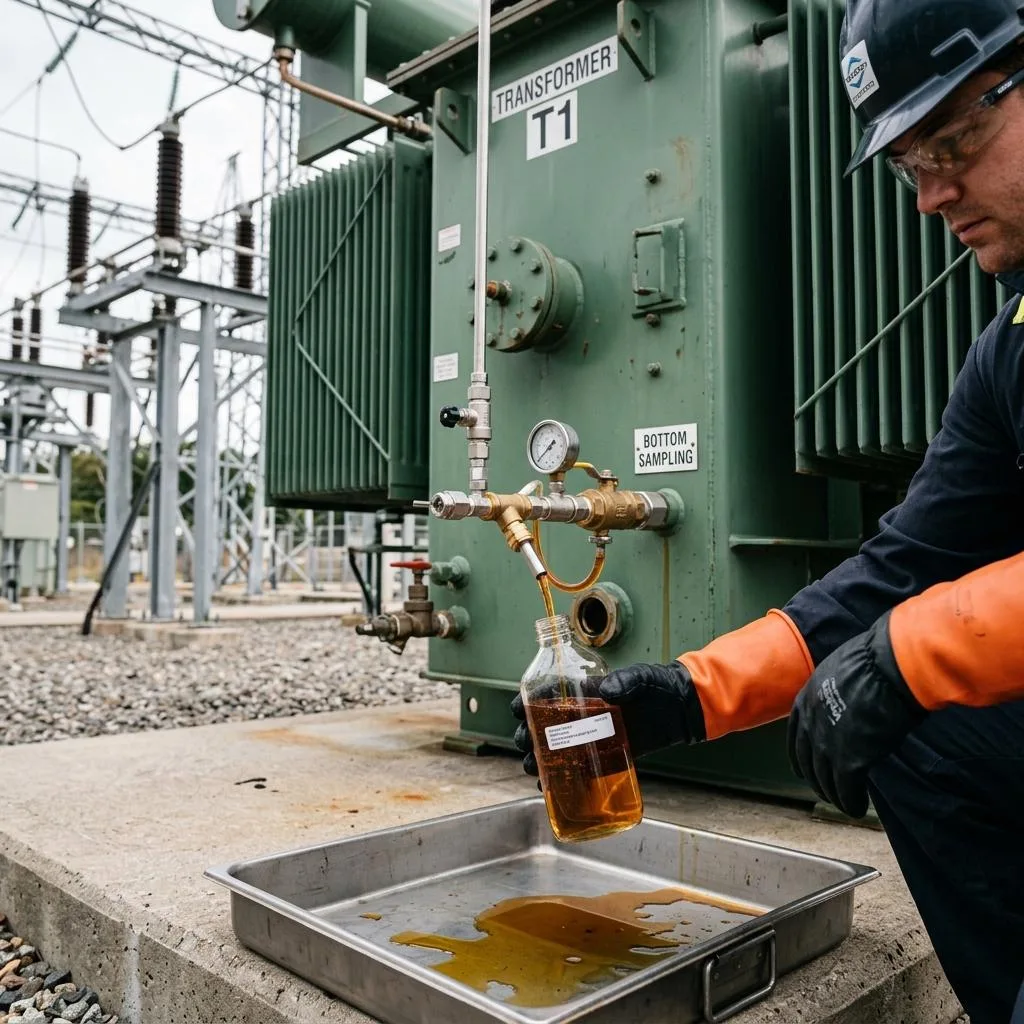
Take the sample where it represents the bulk oil: the bottom drain valve or the dedicated sampling valve.
The exception is deliberate. When you’re chasing a fault, you want an unrepresentative sample — from the OLTC, the selector switch, or the Buchholz relay. That’s a different job with a different answer.
Two-valve transformers: open the outer valve first, then the inner one. Reverse that and you invite air into the tank.
Small oil-volume equipment — bushings, instrument transformers, cables — needs a different mindset. The volume you draw off can compromise the equipment. De-energize. Follow the manufacturer’s instructions to the letter; getting this wrong wrecks hardware. Sample by syringe (that’s the method IEC SC 36A recommends for bushings). Take the sample with the off-load equipment in its normal position, or you’re not measuring its real condition.
Bushings pressurized at ambient temperature: do not sample. The procedure doesn’t apply. Go back to the manufacturer.
One safety item that gets skipped: confirm the oil in energized equipment isn’t under negative pressure before you open anything. Sampling under vacuum pulls air into the tank — bubbles, flashover, and a person standing right next to it.
Flushing — the step people cut short
Pull the blank flange off the sampling valve. Wipe the outlet with a lint-free cloth or an oil-resistant synthetic sponge until no visible dirt remains. Rags are not permitted as a cleaning material anywhere in this standard.
Then flush the drain valve with 2 to 5 litres, under turbulent flow. Turbulent is intentional here — you’re scouring water and particles out of the valve body and the orifice, where they’ve been sitting since the last time anyone touched it. Nitrile gloves, waste bucket.
This gets repeated for every new sample. Not once per transformer. Every sample.
Note the flush volume that follows is separate: once the sampling device is connected, another 1 to 2 litres goes to waste through the three-way valve before you fill anything.
Tubing
Short as possible. Perfluorinated material (Viton, Tygon), PTFE, or metal. Not PVC.
New tubing per sample, or flush it thoroughly and wipe the outer surface with the oil you’re about to sample. For ampoules, the plastic tubing is genuinely single-use — it has a memory effect and will contaminate a DGA sample.
Filling the syringe
The whole procedure is built to keep air out and dissolved gas in.
- Connect, open the equipment sampling valve, and run 1–2 litres to waste through the three-way valve.
- Turn the valve to let oil into the syringe slowly. Do not pull the plunger. Let oil pressure push it back. Pulling creates a vacuum and strips gas out of solution.
- Turn to waste, hold the syringe roughly vertical with the nozzle up, and push the oil out. All the air goes with it. Check that the inner barrel and plunger are fully wetted.
- Repeat the wet-and-purge until no bubble appears.
- Fill, close the syringe stopcock, then close the equipment valve, then disconnect.
Hot oil: stand the syringe in its box vertically, resting on the piston, tip up, and let it cool before packing. Skip this and gas comes out of solution as the oil cools in a fixed volume.
Sealed transformers: if a bubble shows up in the syringe right after sampling, resample. Don’t rationalize it.
There’s a 30-second syringe integrity check worth building into your kit routine: valve closed, pull the piston, hold 30 seconds, release. It should return to position. If air got trapped between piston and barrel, the syringe or valve isn’t sealing — bin it.
Filling a bottle
Different physics, different rules.
Run 1–2 litres to waste under laminar flow (not turbulent — that was the valve-cleaning step; here turbulence strips gas). Put the tube end at the bottom of the bottle and fill from the bottom up. Rinse with about a third of a bottle, dump it. Then let roughly two bottle volumes overflow to waste, and withdraw the tube slowly with oil still running.
If the bottle takes more than a few minutes to fill, throw the sample away and start again — you’ve lost gas to the atmosphere.
Flexible metal bottles: squeeze the sides so the bottle is entirely full of oil, then cap. No headspace, no expansion device needed. Retighten the cap once the oil has cooled to ambient.
Glass and rigid metal bottles: the opposite. Do not fill completely. Leave 1.5 to 3 cm of airspace (roughly 3.5–7 ml) so the oil can expand, but fill to at least 90% so the bottle doesn’t implode when it cools. Write the approximate air volume on the label — the lab needs it to correct for gas partitioning into the headspace.
Clear glass gets protected from sunlight. Dark bottles are better.
Gaskets: PE, PTFE, or NBR with more than 30% nitrile for mineral oil. For esters, PTFE only — not NBR, not silicone. Single use, unless aluminium-lined on the oil side. The acceptance criterion for any bottle-and-seal combination used for DGA is hydrogen loss below 2.5% per week.
Water content deserves its own paragraph
Sample on the driest day you can. High ambient humidity condenses moisture onto the sampling equipment and straight into your sample. And measure the oil temperature with a thermometer in the flowing oil — not the tank gauge, not the WTI. Record the method you used and whether fans and pumps were running. Without that temperature, relative saturation cannot be calculated, and ppm on its own tells you much less than people think.
The label
The standard gives a checklist. The ones people forget:
- Sampling point (which valve)
- Who took it
- Reason for the sample — routine or investigation
- Whether the transformer was de-energized, energized off-load, or on-load
- Oil temperature at sampling, and how it was measured
- Weather: dry / wet / fog / indoors
- Date of the last oil treatment
- Time of sampling, if more than one sample was taken
Plus the obvious equipment identity: customer, location, serial number, manufacturer, type, MVA, voltage ratio, OLTC type and location, commissioning date, oil type and product name, oil volume.
Transport
Light drives oxidation, which consumes dissolved oxygen and generates hydrocarbons and carbon oxides — the exact things you’re about to measure. Wrap transparent devices in something opaque or box them.
Ship syringes vertically, piston up, for DGA. If the sample flies, a sealed box eliminates the bubble risk from reduced cabin pressure, but the plunger must still be free to move.
And then: get it to the lab. Every day of delay is a day of gas exchange through the seals.
New oil in drums and tankers
Different problem. Here you sample from where the oil is most contaminated — the bottom — because you’re checking a delivery.
- Tankers: let the vehicle stand at least 1 hour. Clean the outlet valve, then run at least 10 litres to waste (at minimum, the pipe volume). Rinse the bottles with the oil itself. Fill at constant flow to avoid turbulence.
- Drums: let them stand at least 8 hours, bung up, protected from rain. Sample from ~3 mm off the bottom with a pipette or a siphon.
- How many drums: negotiate it with the supplier. A typical basis is 10% of the drums, or at least two — whichever is more.
- Typical quantity: 2 litres.
- Composite = same level, several containers. Individual = one container. Average = several levels, one container. Say which one it is on the sampling report.
Rain, fog, high wind: only sample outdoors if you can cover the operation properly. Warm the sampling gear above ambient to stop condensation. Don’t touch the wetted surfaces with your hands. And when the sample reaches the lab, let it come to room temperature before the container is opened.
FAQ
How much oil do I flush before taking a transformer sample?
Two stages. 2–5 litres through the drain valve under turbulent flow to clean it out, then a further 1–2 litres through the sampling device before you fill the syringe or bottle.
Can I use a plastic bottle for DGA?
No. The standard does not permit plastic bottles for DGA, water content or breakdown voltage. Gases diffuse through the plastic wall in both directions.
Should a glass bottle be filled to the top?
No. Leave 1.5–3 cm of headspace so the oil can expand, but fill to at least 90%. Note the air volume on the label. Flexible metal bottles are the opposite — fill them completely and squeeze out the air.
Why can’t I pull the syringe plunger back?
Pulling creates a partial vacuum and strips dissolved gases out of solution. Let the oil pressure push the plunger back on its own.
A bubble appeared in the syringe. Now what?
On a sealed transformer, resample. A bubble means gas has already come out of solution, and the DGA result will read low.
Does oil temperature really need to be recorded?
Yes, for any moisture assessment. Water content in ppm is meaningless without the oil temperature and the pump/fan status, because relative saturation — not ppm — is what tells you whether the paper is wet.