
Transformer oil testing is the cheapest diagnostic port you have. You open a valve, fill a bottle, and get a readout of what is happening inside a sealed tank you will probably never open.
But a number on a lab report means nothing on its own. 22 mg/kg of water is fine in a 33 kV distribution unit and a problem in a 400 kV autotransformer. 45 kV breakdown voltage is a pass in one category and a fail in another. The limits move with the equipment.
IEC 60422 is the standard that sorts this out. It groups the tests, sets limits by equipment category, and tells you what to do when a result goes bad. This article walks through it the way you would actually use it: what to test, what the number means, and what happens next.
Table of Contents
Quick reference
| Question | Short answer |
|---|---|
| Which standard | IEC 60422:2013 Ed. 4.0, Mineral insulating oils in electrical equipment – Supervision and maintenance guidance |
| Applies to | Mineral oils originally supplied to IEC 60296, in transformers, switchgear and similar apparatus |
| Test groups | Group 1 routine, Group 2 complementary, Group 3 special investigative |
| Routine tests | Colour/appearance, breakdown voltage, water, acidity, DDF/resistivity, inhibitor content |
| Condition classes | Good / Fair / Poor |
| Two failure modes | Physical contamination → recondition. Chemical degradation → reclaim or replace |
| Not covered | Dissolved gas analysis and furans are explicitly outside this standard’s scope |
Why oil tells you so much
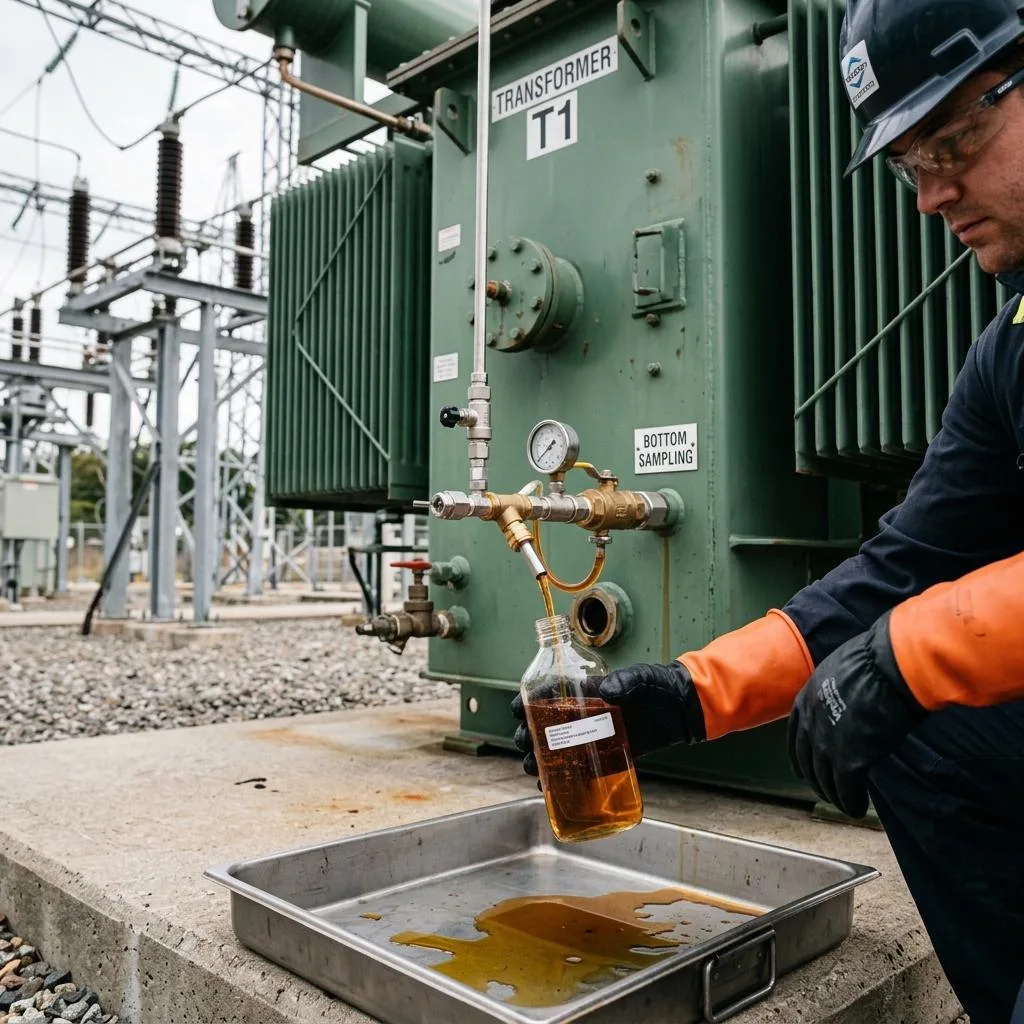
The oil does three jobs at once: it insulates, it carries heat, and in switchgear it quenches the arc. To do all three it has to stay dry, clean, and chemically stable.
It does not stay that way. Oxygen gets in. Temperature drives oxidation. Metals and organo-metallic compounds catalyse it. The oil darkens, acids form, and eventually sludge drops out. Meanwhile water arrives from the atmosphere and from the cellulose breaking down, and particles arrive from wear, ageing, and the tap-changer.
Every one of those processes shows up as a change in a measurable oil property. That is the whole basis of oil condition monitoring.
One thing worth being clear about: this standard covers oil quality. It does not cover dissolved gas analysis or furanic compounds. Those tell you about fault gases and paper ageing. Oil testing tells you about the oil. Use both.
The three test groups
IEC 60422 splits the test list into three tiers. This matters because it decides what you pay for on a routine cycle and what you only pay for when something looks wrong.
Group 1 — routine tests. The minimum set needed to confirm the oil is fit to stay in service. If nothing exceeds the action limits, you usually do nothing until the next scheduled inspection.
- Colour and appearance (ISO 2049)
- Breakdown voltage (IEC 60156)
- Water content (IEC 60814, Karl Fischer)
- Acidity / neutralisation value (IEC 62021-1 or -2)
- Dielectric dissipation factor and resistivity (IEC 60247)
- Inhibitor content (IEC 60666) — inhibited oils only
Group 2 — complementary tests. Extra information when the routine set raises a question.
- Sediment and sludge (method given in IEC 60422)
- Interfacial tension (ASTM D971 or EN 14210)
- Particle count and sizing (IEC 60970)
Group 3 — special investigative tests. Run these to answer a specific question, not on a calendar.
- Corrosive sulfur (IEC 62535, ASTM D1275 Method B, DIN 51353)
- DBDS content (IEC 62697-1)
- Passivator content (IEC 60666)
- PCB content (IEC 61619)
- Oxidation stability (IEC 61125)
- Flash point, pour point, density, viscosity, compatibility
Flash point, pour point, density and viscosity are not condition indicators in the normal sense. They are type-identification tests. They tell you whether someone topped up with the wrong oil.
The routine tests, and what they actually mean
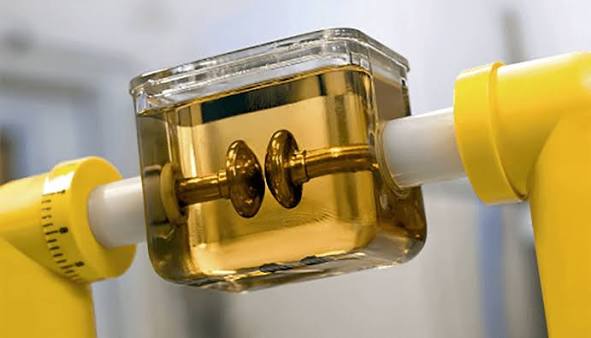
Breakdown voltage
BDV measures the oil’s ability to hold off electric stress. It is the headline number, and it is also the one most often misread.
BDV does not measure oil quality. It measures contamination. Free water and solid particles migrate to regions of high stress and collapse the breakdown voltage. Dissolved water plus particles is a worse combination than either alone.
The asymmetry matters: a low BDV proves contamination is present. A high BDV proves nothing. Clean-looking oil can still be chemically finished.
And BDV is strongly temperature-dependent, through its dependence on water. The value only means something if the oil was sampled at the transformer’s operating temperature. A sample pulled below 20 °C and tested at room temperature will read optimistically — the water is dissolved, it is not doing damage in the test cup, and you get a comfortable number from a wet transformer.
Watch spare units especially. A unit that sat out of service for a year and then went back on load needs more frequent BDV checks until it reaches steady state.
Water content
Water is the one that drives everything else. It cuts breakdown voltage, it attacks the solid insulation, and it accelerates ageing of both the liquid and the paper.
Two sources: ingress from the atmosphere, and degradation of the cellulose itself.
Three numbers get used and they are not the same thing:
- Absolute water content (Wabs), in mg/kg. Karl Fischer, per IEC 60814. Independent of oil temperature and condition.
- Water solubility (Ws), in mg/kg. Depends on oil temperature, oil type, and oil condition.
- Relative water content (Wrel) = Wabs / Ws, as a percentage. This is the saturation figure that on-line capacitive sensors report.
Solubility rises with temperature:
Ws = Woil · e^(−B/T), with T in kelvin.
The constants are similar across most transformer oils but not identical — aromatic content changes them. And here is the trap: as oil oxidises, its water solubility goes up. Polar ageing by-products hold water. An oxidised oil at 0,3 mg KOH/g acidity can carry far more dissolved water than the same oil when new, at the same temperature. So a “safe” mg/kg reading in an aged oil is not the same safe as it was ten years ago.
Above saturation, the excess cannot stay dissolved. You get haze, then droplets.
In a transformer, most of the water is in the paper, not the oil. Small temperature changes swing the dissolved water in the oil a lot and barely move the water in the paper. That is why calculating paper moisture from a single oil sample is unreliable. Theory and field results routinely disagree, and drying rarely pulls out as much water as the calculation predicts.
Correcting to 20 °C. For trending on a steadily loaded unit, normalise the water result:
f = 2,24 · e^(−0,04 · ts) where ts is oil sampling temperature in °C
Measured 10 mg/kg at 40 °C → f = 0,45 → corrected value 4,5 mg/kg.
Two rules on this. The corrected value is for comparing results across different sampling temperatures only — the real water content at the sampling point is the measured value, not the corrected one. And the formula does not apply below 20 °C, because below 20 °C water diffusion is too slow for the oil and paper to reach equilibrium anyway.
Per-cent saturation gives a rough read on the cellulose:
| Water saturation in oil | Condition of cellulosic insulation |
|---|---|
| < 5 % | Dry |
| 5 % to 20 % | Moderately wet — bottom of range fairly dry, top of range genuinely moist |
| 20 % to 30 % | Wet |
| > 30 % | Extremely wet |
This only holds if the oil and paper are actually in equilibrium, there is no active leak, there is paper in the equipment, and there is no free water.
Acidity
Acidity (neutralisation value, mg KOH/g) measures the acidic products of oxidation.
The absolute number matters, but the rate of increase is the better indicator. That slope is your ageing rate.
Acids do not just sit there. Together with water and solid contaminants they degrade the dielectric properties of the oil, they attack the cellulose, and they can corrode metal parts inside the tank.
For inhibited oil, expect essentially no rise in acidity while enough inhibitor remains. When acidity starts climbing on an inhibited oil, the inhibitor is gone or nearly gone. That is the signal.
Dielectric dissipation factor and resistivity
DDF and resistivity are the sensitive ones. They pick up soluble polar contaminants, ageing products and colloids at concentrations below what chemical detection will find.
They move together — resistivity falls as DDF rises. You do not normally need both. DDF is the more common test in practice.
The useful trick is to measure at two temperatures: ambient and 90 °C.
- Good result at both temperatures → oil is in reasonable shape.
- Satisfactory at 90 °C, bad at ambient → water or degradation products precipitating in the cold. Not necessarily deep chemical degradation. Often recoverable.
- Bad at both temperatures → extensive contamination. Reconditioning may not bring it back.
One warning specific to instrument transformers: on VHV and UHV units, a high DDF has been linked to thermal runaway and failure. Give it more weight there, not less.
Inhibitor content
Inhibited oils age differently. Early in life the synthetic inhibitor is consumed and almost no oxidation products form — this is the induction period. Once the inhibitor is spent, oxidation rate reverts to whatever the base oil’s own stability is, and things move quickly.
So you monitor the inhibitor, not the damage. Measure concentration per IEC 60666. The usual inhibitors are DBPC (2,6-di-tert-butyl-paracresol) and DBP (2,6-di-tert-butyl-phenol).
A falling interfacial tension is often the early warning that oxidation products are starting to form in an inhibited oil, ahead of any acidity movement.
The complementary tests
Interfacial tension
IFT measures the tension between oil and water, and it detects soluble polar contaminants and degradation products.
It moves fast early in ageing, then flattens off while deterioration is still moderate. That makes it a good early indicator and a poor late one.
Uninhibited oils drop IFT faster than inhibited ones. A sudden fall can also mean something other than ageing: incompatibility between the oil and a varnish or gasket, or accidental contamination during an oil fill. Overloaded units degrade materials fast, and IFT catches it.
Sediment and sludge
The standard separates the two.
Sediment is insoluble matter already in the oil: insoluble oxidation and degradation products, carbon and metal particles, metal oxides and sulfides, fibres and general foreign matter.
Sludge is polymerised degradation product. It is soluble in oil up to a limit that depends on the oil and the temperature. Above that limit it precipitates — and then it becomes sediment.
Both are bad news, and not only electrically. Deposits block heat exchange, which raises temperature, which accelerates degradation of everything else.
Method: weigh a P10 glass filter or an 8 µm membrane to 0,1 mg, filter 100 g of homogenised oil, flush with 100 ml of n-heptane until the filter is oil-free, dry at 105 °C, reweigh. Results below 0,02 % by mass can be ignored.
Particle count
Particles come from everywhere: manufacturing residue, unfiltered storage and handling, bearing wear in the oil pumps, ageing of oil and solids. Local overheating above 500 °C makes carbon particles. Carbon from the on-load tap-changer diverter switch can leak into the main tank and contaminate the whole oil volume.
The damage a particle does depends on what it is (metal, fibre, sludge) and how much water it is carrying.
The key point for anyone relying on BDV alone: particle contamination has caused HV transformer failures that conventional breakdown voltage testing did not catch. Counting (IEC 60970, coded to ISO 4406) exists because BDV was not enough.
The special tests worth knowing about
Corrosive sulfur and DBDS
This is the one that surprises people. Certain sulfur compounds in the oil react with copper and deposit copper sulfide (Cu₂S) in the paper insulation. The paper’s dielectric strength drops. Units have failed from it.
Conditions that favour Cu₂S deposition: corrosive sulfur in the oil, unvarnished or unprotected copper, high operating or ambient temperature, and limited oxygen — which means sealed units are more exposed, not less.
Three test methods, and they are not interchangeable:
- IEC 62535 — the demanding one. All oils shall pass it.
- ASTM D1275 Method B — easier to run, usable as an initial screen. A negative result may still need follow-up.
- DIN 51353 — silver strip at 100 °C. Complementary. It has to be passed in addition to either of the above before an oil is called “non-corrosive.”
DBDS (dibenzyl disulfide) is the main culprit compound. It shows up in most corrosive insulating oils blended after 1988–89 — oils that passed the corrosivity tests of their day. Very few oils made after 2006 contain detectable DBDS. But note: some oils in service are corrosive with no DBDS present. Absence of DBDS is not a clean bill of health.
Two practical cautions. Heavily aged oils with high acidity, or poor oxidation stability, can throw ambiguous IEC 62535 results because of heavy sludge on the paper strip. SEM-EDX analysis resolves those. Also, running the test on paper alone, without the copper strip, and comparing appearance, will expose false positives.
And these tests only apply to oils without a metal passivator. If passivator is present it has to be removed first — IEC 60296 gives the removal method.
Passivator
The standard mitigation for corrosive sulfur is a metal passivator — typically a toluyltriazole derivative, dosed around 100 mg/kg (0,01 % by weight), to block copper’s reaction with sulfur.
Passivator gets consumed. Monitoring the passivator content in service is essential, and it is the one test IEC 60422 says to run every six months or less, depending on how fast it is dropping.
The other thing to know about passivation: it is not a permanent fix. The older the oil at the time of passivation, and the harder the operating conditions, the higher the chance passivation does not hold long-term.
PCB
Measure it in new equipment to confirm the oil is PCB-free. After that, test whenever there is a credible contamination risk — oil treatment, repairs, shared handling equipment. Limits are set by local regulation, not by IEC.
Cross-contamination through shared handling facilities is how most PCB contamination in mineral oil happened. It is also how it still happens. Dedicated hoses, dedicated drums, dedicated plant.
Flash point
Not a routine test, but a meaningful one. A flash point drop means low-molecular-weight hydrocarbons in the oil. Cause is either solvent contamination, or — and this is the one that matters — extensive sparking discharges inside the unit.
A drop of more than 10 % from the original value calls for investigation, and probably an internal inspection.
Categories: why the limits move
IEC 60422 does not give one limit per test. It gives a limit per test per equipment category. Here are the categories in short form:
| Category | Equipment |
|---|---|
| O | Power transformers / reactors, 400 kV and above |
| A | Power transformers / reactors above 170 kV and below 400 kV. Also any rated voltage where continuity of supply is vital, or where duty is onerous |
| B | Power transformers / reactors above 72,5 kV up to 170 kV |
| C | MV/LV power transformers up to 72,5 kV, traction transformers. Oil circuit breakers above 72,5 kV. Oil switches and AC metal-enclosed switchgear at 16 kV and above |
| D | Instrument / protection transformers above 170 kV |
| E | Instrument / protection transformers up to 170 kV |
| F | Diverter tanks of on-load tap-changers |
| G | Oil circuit breakers up to 72,5 kV. Oil switches and switchgear below 16 kV |
Two notes worth catching. A separated selector tank of an OLTC takes the same category as its transformer, not category F. And a risk assessment can push any unit up a category regardless of size or voltage — a 10 MVA unit feeding a process that cannot go down is a Category A problem, not a Category C one.
Limits for new equipment, before energising
Once oil has been in contact with the windings and solid insulation, it is no longer “unused oil” in the IEC 60296 sense — even if the unit was never energised. It gets judged as in-service oil.
Recommended limits after filling, before energising:
| Property | < 72,5 kV | 72,5–170 kV | > 170 kV |
|---|---|---|---|
| Appearance | Clear, no sediment or suspended matter | — | — |
| Colour (ISO 2049) | max 2,0 | max 2,0 | max 2,0 |
| Breakdown voltage | > 55 kV | > 60 kV | > 60 kV |
| Water content | 20 mg/kg (by agreement) | < 10 mg/kg | < 10 mg/kg |
| Acidity | max 0,03 mg KOH/g | max 0,03 | max 0,03 |
| DDF at 90 °C, 40–60 Hz | max 0,015 | max 0,015 | max 0,010 |
| Resistivity at 90 °C | min 60 GΩ·m | min 60 | min 60 |
| Interfacial tension | min 35 mN/m | min 35 | min 35 |
| Corrosive sulfur | Non-corrosive | ||
| DBDS | < 5 mg/kg | ||
| Total PCB | Not detectable (< 2 mg/kg) | ||
| Particles | — | — | Baseline measurement recommended |
The water values here are not temperature-corrected. Not enough time has passed for oil and cellulose to reach equilibrium.
A high DDF at this stage is a red flag for excessive contamination or the wrong solid materials used in manufacture. Investigate it before you energise, not after.
In-service limits: good, fair, poor
This is the core of the standard. Three classes:
- Good — normal condition. Continue normal sampling.
- Fair — deterioration detectable. Sample more often. Check the related parameters.
- Poor — abnormal deterioration. Schedule action.
Breakdown voltage (kV)
| Category | Good | Fair | Poor |
|---|---|---|---|
| O, A, D | > 60 | 50–60 | < 50 |
| B, E | > 50 | 40–50 | < 40 |
| C | > 40 | 30–40 | < 30 |
| F | Action if < 30 kV (OLTC, star-point) or < 40 kV (OLTC, delta or line-end) | ||
| G | < 30 → action |
Water content (mg/kg, at operating temperature)
| Category | Good | Fair | Poor |
|---|---|---|---|
| O, A | < 15 | 15–20 | > 20 |
| B, D | < 20 | 20–30 | > 30 |
| C, E | < 30 | 30–40 | > 40 |
| F | Action if > 40 |
Acidity (mg KOH/g)
| Category | Good | Fair | Poor |
|---|---|---|---|
| O, A, D | < 0,10 | 0,10–0,15 | > 0,15 |
| B, E | < 0,10 | 0,10–0,20 | > 0,20 |
| C | < 0,15 | 0,15–0,30 | > 0,30 |
Acidity of 0,15 mg KOH/g is the point where the reclaim-or-replace decision starts getting made.
Dielectric dissipation factor (90 °C, 40–60 Hz)
| Category | Good | Fair | Poor |
|---|---|---|---|
| O, A | < 0,10 | 0,10–0,20 | > 0,20 |
| B, C | < 0,10 | 0,10–0,50 | > 0,50 |
| D | < 0,01 | 0,01–0,03 | > 0,03 |
| E | < 0,10 | 0,10–0,30 | > 0,30 |
Note how much tighter Category D is. HV instrument transformers get a limit an order of magnitude below everything else, and for good reason — see the thermal runaway note above.
Resistivity (GΩ·m)
| Category | Good | Fair | Poor |
|---|---|---|---|
| At 20 °C | |||
| O, A | > 200 | 20–200 | < 20 |
| B, C | > 60 | 4–60 | < 4 |
| D | > 800 | 250–800 | < 250 |
| E | > 60 | 7–60 | < 7 |
| At 90 °C | |||
| O, A | > 10 | 3–10 | < 3 |
| B, C | > 3 | 0,2–3 | < 0,2 |
| D | > 50 | 10–50 | < 10 |
| E | > 3 | 0,4–3 | < 0,4 |
Interfacial tension (mN/m), categories O, A, B, C, D
| Oil type | Good | Fair | Poor |
|---|---|---|---|
| Inhibited | > 28 | 22–28 | < 22 |
| Uninhibited | > 25 | 20–25 | < 20 |
Inhibitor and passivator
| Property | Good | Fair | Poor |
|---|---|---|---|
| Inhibitor content | > 60 % of original | 40–60 % of original | < 40 % of original |
| Passivator content | > 70 mg/kg, stable (loss < 10 mg/kg/yr) | 50–70 mg/kg, or < 70 with loss > 10 mg/kg/yr | < 50 mg/kg and falling > 10 mg/kg/yr |
Re-inhibiting a “fair” oil is worth considering — but only if acidity is still below 0,08 mg KOH/g and IFT is above 28 mN/m. Past that, you are re-inhibiting an oil that has already started down the slope.
The rule that overrides all of the above
No action on a single result and a single property. Confirm with a repeat sample. Read the number against the trend, not against the table alone. A 0,12 mg KOH/g acidity that has been flat for six years is a different animal from a 0,12 that was 0,04 last year.
Sampling: where most bad results come from
Oil gets rejected unjustifiably all the time because someone took a careless sample. Sampling per IEC 60475, by someone trained to do it.
Non-negotiables:
- Sample at normal operating conditions, or very shortly after de-energisation. Not on a cold unit that has been off for a week.
- Measure oil temperature directly in the oil stream at the sampling point. If you use top-oil indicator readings instead, or apply corrections for ONAN or OFAF cooling mode, write that down explicitly on the report.
- Clean the sampling valve before sampling.
- Clean containers. Contamination in the sample bottle produces a lab result about the sample bottle.
- Keep transport and storage time short.
Field testing has its place. Visual inspection, BDV and water can be done on site with results reliable enough for acceptance testing. Acidity can be done on site with reduced accuracy. Most field testing is used to screen — to decide which samples need to go to a lab.
The oil failed. Now what?
IEC 60422 sorts corrective action into two buckets, and getting the bucket right is most of the decision.
| Bucket | Symptoms | Action |
|---|---|---|
| Physical | High water. Low breakdown voltage. High particle count. Turbid oil. | Reconditioning |
| Chemical | High colour. Low IFT. High acidity. High DDF. Sediment or sludge. Low inhibitor. Low passivator. | Reclaiming, or replace the oil, or restore additives |
| PCB | PCB detectable | Local regulations |
| Corrosive sulfur | Oil corrosive | Risk assessment, then passivate / change / reclaim |
Reconditioning — physical only
Filtration, centrifuging, vacuum dehydration. Removes water, particles, dissolved gases. Sometimes takes out some 2-furfural too, so re-baseline your furan trending afterwards.
Choose by temperature:
- Cold treatment at atmospheric pressure — best for particles and free water.
- Hot vacuum treatment — best for dissolved and free water plus dissolved gases.
- Sludge and free water are more soluble in hot oil. That is why cold works better for those.
- If you are not using vacuum, keep it below 30 °C.
- If you are using vacuum, do not exceed the oil’s initial boiling point. If you do not know it, 85 °C is the ceiling.
The thing people miss: vacuum plus heat strips inhibitor. DBPC and DBP are more volatile than the oil. Process an inhibited oil too hot or too hard and you will remove the additive along with the water. IEC 60422 gives minimum pressures to protect against this:
| Temperature | Minimum pressure |
|---|---|
| 40 °C | 8 Pa |
| 50 °C | 15 Pa |
| 60 °C | 30 Pa |
| 70 °C | 80 Pa |
| 80 °C | 200 Pa |
| 85 °C | 280 Pa |
Same applies to passivator.
If you are circulating through the unit, expect at least three passes of the total oil volume. Draw from the bottom, return smoothly and horizontally at or near the top oil level so you do not blend clean oil back into dirty. Keep going until a sample from the bottom, after a few hours’ settling, passes BDV. Then let it stand — no less than 12 h de-aeration before commissioning a power transformer.
And keep tap-changer oil equipment separate. Carbon from a diverter tank cross-contaminates everything it touches.
Reclaiming — chemical
Percolation through fuller’s earth (or sepiolite, bentonite, attapulgite, montmorillonite), typically at 60–80 °C, after filtration and before a final vacuum/centrifuge stage. Again, three passes minimum.
Two facts that change the economics:
- Reclaimed oil is less oxidation-stable than new oil. Reclaiming an oil of moderate-to-high acidity gives you back an oil with lower oxidation resistance than the original. You have bought time, not a new oil.
- The adsorbent absorbs about 5 % of your oil. Budget unused oil for topping up.
Run a laboratory feasibility test before committing to a field reclamation. Contact reclaiming — stirring oil with fuller’s earth in a container — is impractical in the field but is exactly what the lab uses to predict what field reclamation will achieve. Cheap answer to an expensive question.
And after reclaiming: the additives are gone. Reclamation strips inhibitor, and it strips metal passivator too, because passivators are polar. Restore both before re-energising.
Replacement
Sometimes cheaper than reclaiming. Note that up to 10 % of the original oil stays adsorbed in the solid insulation, and its contaminants will migrate back out into the new oil over time. A fresh fill is not a fresh start.
When topping up, use oil of the same IEC 60296 classification. Under about 5 % addition to a “good” oil is normally uneventful. Larger additions to heavily aged oil can precipitate sludge. Mixing used oils needs a compatibility study — foaming, oxidation stability per IEC 61125 Method C, and corrosive sulfur after ageing.
How often to test
Group 1 routine tests, by category:
| Category | O | A | B | C | D | E | F | G |
|---|---|---|---|---|---|---|---|---|
| Interval (years) | 1–2 | 1–3 | 1–4 | 2–6 | 1–2 | 2–6 | 2–6 | 2–6 |
Group 1 tests are also mandatory after filling or refilling, before energising.
Group 2 and Group 3: periodically, less often than routine, driven by oil type, age and equipment. Take a benchmark measurement on new or refurbished equipment before energisation — without it, later results have nothing to trend against.
Passivator content is the exception: six months or less.
Shorten intervals when:
- Any property lands in fair or poor
- An abnormal ageing trend appears
- The unit is heavily loaded (higher temperature, faster oxidation)
- The oil is PCB-contaminated (environmental exposure)
Lengthen them, cautiously, when the unit has a well-maintained system controlling the oil’s exposure to atmosphere, and your life-cycle analysis supports it.
The short version
- Test at operating temperature or the numbers lie to you.
- BDV finds contamination. It does not find chemical ageing. High BDV proves nothing.
- Water solubility rises as oil oxidises — a stable mg/kg reading in an ageing oil is not stable safety margin.
- DDF at two temperatures separates “wet and cold” from “chemically finished.”
- Acidity slope beats acidity value.
- For inhibited oil, watch the inhibitor, not the damage.
- Physical problem → recondition. Chemical problem → reclaim or replace.
- Reclaiming strips inhibitor and passivator. Put them back.
- Never act on one result and one property.
FAQ
What is the difference between reconditioning and reclaiming transformer oil?
Reconditioning is physical only — filtration, centrifuging, vacuum drying. It removes water, particles and gases. Reclaiming is chemical and physical — it uses adsorbents like fuller’s earth to strip soluble and insoluble polar contaminants. Reconditioning fixes a wet, dirty oil. Reclaiming fixes an acidic, oxidised one.
Can I judge transformer oil condition from breakdown voltage alone?
No. BDV detects contamination — water and particles. It says nothing about acidity, oxidation, sludge or corrosive sulfur. Oils have failed transformers with acceptable breakdown voltage, particularly through particle contamination in HV units.
Why does water content need a temperature correction?
Water solubility in oil rises with temperature, so the same absolute water content reads very differently depending on when you sampled. IEC 60422 gives a correction factor, f = 2,24 · e^(−0,04 · ts), to normalise results to 20 °C for trending. The correction is for comparison across samples only — the actual water content at the sampling point is the measured value.
Does IEC 60422 cover dissolved gas analysis?
No. DGA and furanic compound analysis are explicitly outside its scope. IEC 60422 covers oil quality — the oil’s ability to keep doing its job. DGA covers fault gases. They answer different questions and you need both.
How often should transformer oil be tested?
Routine tests run every 1–2 years for 400 kV units, up to 2–6 years for distribution transformers and switchgear. Passivator content, where used, needs checking every six months or less. Shorten intervals whenever a result goes into the “fair” band or the trend accelerates.
What is DBDS and why does it matter?
Dibenzyl disulfide is a corrosive sulfur compound found in many insulating oils blended between roughly 1988 and 2006. It reacts with copper and deposits copper sulfide in the paper insulation, reducing its dielectric strength. It has caused in-service failures. New oil limits are below 5 mg/kg. Note that some oils are corrosive without containing any DBDS — a negative DBDS result is not a clean bill of health.