Of all the tests you can run on transformer oil, this is the one that gets run first. It’s fast, it’s cheap, and a single number in kilovolts tells you whether the oil is doing its main job: holding off voltage without arcing.
The breakdown voltage test — BDV — measures the highest voltage the oil can take across a fixed gap before a spark jumps through it. That number is a front-line health check. A good one means the oil is clean and dry enough to insulate. A bad one means something is in there that shouldn’t be — almost always water, particles, or both.
But the BDV number is also easy to misread. A high reading doesn’t mean the oil is fine, and the spread of the readings often tells you more than the average does. Here’s how the test actually works, what it catches, and what it quietly misses.
Table of Contents
How the test runs
The test is mechanically simple. You pour the oil sample into a standard cell holding two electrodes — mushroom- or sphere-shaped, made of brass, bronze, or stainless steel and kept polished — set a precise distance apart. Under IEC 60156, that gap is 2.5 mm. You then raise an AC voltage across the electrodes from zero at a steady 2 kV per second until the oil breaks down and an arc jumps the gap. The voltage at the instant of that arc is the breakdown voltage, recorded in kV.
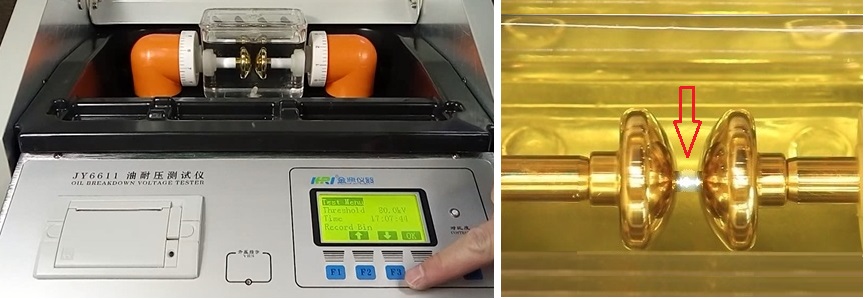
One reading isn’t the answer. The standard calls for six breakdowns on the same cell filling, with a pause of at least two minutes between each one to let the oil settle and any gas disperse. The result is the mean of those six. Many test sets also offer a gentle stirrer to keep the oil mixed between shots.
A practical note worth knowing: a lot of field meters top out around 60 kV. For new or well-maintained oil that’s usually fine, but oil being processed for installation can read higher than the instrument can display, so you may need a set that measures further up.
What a low number is telling you
A low BDV almost always comes down to two things.
Water. Even a trace of free or emulsified water slashes the breakdown voltage. Water has a far lower dielectric strength than oil, and under the field it migrates to the high-stress region right between the electrodes — exactly where it does the most damage. This is why moisture control is the heart of oil maintenance.
Particles. Fibres shed from the paper insulation, metal flakes, carbon, sludge — any of these can partly bridge the gap and give the streamer an easy path. Particles get worse when there’s water around, because damp fibres conduct.
So a low number is a reliable alarm. It tells you the oil is contaminated, even if it can’t tell you which of the two it is. That’s a job for the moisture and particle-count tests that sit alongside this one.
What a high number does not tell you
Here’s the trap. A high BDV does not prove the oil is clean or dry.
The test is most sensitive to free water and particles — the things that physically bridge the gap. It’s far less sensitive to dissolved water, the moisture held in solution in the oil and, more importantly, in the paper. Oil can sit at a comfortable BDV while carrying a moisture load that’s quietly aging the insulation and waiting to come out of solution the moment the transformer cools.
That’s the whole reason BDV and Karl Fischer moisture testing are run together: BDV catches the free water and particles, Karl Fischer catches the dissolved water. Lean on the breakdown number alone and you can declare healthy oil that’s actually wet. A high BDV is necessary, not sufficient.
The six readings are the real story
Most people glance at the average and move on. The more useful information is in the spread of the six breakdowns.
Clean, uniform oil breaks down at almost the same voltage every time — the six values cluster tightly and the standard deviation is small. When particles are present, the readings scatter: one shot breaks low because a fibre happened to drift into the gap, the next breaks high because it didn’t. Wide scatter is a fingerprint of particle contamination, even when the average still looks acceptable.
So when you read a set of results, read the consistency, not just the mean. A 60 kV average made of six readings all within a volt of each other is a very different oil from a 60 kV average that swung from 35 to 80. Same number, completely different condition.
This isn’t just field lore — IEC 60156 treats it formally. The standard characterises the scatter as a standard-deviation-to-mean ratio (the coefficient of variation) and notes that the expected spread depends on the level of the result: it’s widest for mid-range breakdown values and tightens at high ones. The practical upshot is to judge the scatter against the mean, not in absolute kV. A few kV of spread at a 70 kV average is normal; the same few kV at a 30 kV average is not.
Sampling and temperature — where it goes wrong
The test is brutally sensitive to how the sample was taken. The contamination you’re trying to measure is so small that a careless sample adds more than the oil contained to begin with.
- Keep air out. Oil pulls moisture straight from humid air. Use a clean, dry container, fill it full, cap it fast. On a damp day this is the single biggest source of a false low reading.
- Let it rest. Air bubbles in the gap break down early and drag the number down. After filling the cell, wait — the standard starts the first voltage application about five minutes after filling — and check that no bubbles are visible in the gap before you begin.
- Clean the cell and electrodes. Rinse the vessel with the oil to be tested, and keep the electrode faces clean and correctly gapped. Carbon residue from previous arcs skews everything.
- Mind the temperature. The test itself is run on the oil as received, without drying or degassing, with the liquid near room temperature — referee tests call for 20 °C ± 5 °C — and the liquid temperature measured and recorded. Where the temperature really bites is at sampling. The number is most representative when the oil is drawn at the transformer’s operating temperature; a sample pulled from a cold transformer and then tested warm can read optimistically high, because warming lets free water dissolve back into the oil and the BDV looks better than the oil really is. Draw the sample from the lowest, most contaminated point, and note the temperature.
What counts as a good number
Acceptance depends on whether the oil is new or in service, and on the voltage class.
For new oil, checked before it goes into the transformer, the bar is high — well above 70 kV is the usual expectation for properly processed mineral oil. Once the oil is in service, the limits come from the maintenance standard and scale with voltage class: higher-voltage transformers demand higher breakdown voltages and trigger action sooner, while distribution units are held to lower thresholds. Use the voltage-class table in the in-service oil standard for the specific figure rather than a single blanket number.
One terminology point that trips people up: breakdown voltage (in kV) is not the same as dielectric strength (in kV/mm). Dielectric strength is the breakdown voltage divided by the gap. Because the BDV test fixes the gap at 2.5 mm, the field tends to use the two terms interchangeably — but if you ever compare results from different gaps or standards, the distinction matters.
Where it sits
Breakdown voltage is the gate, not the whole picture. It’s the quick screen that tells you whether to worry, run alongside Karl Fischer moisture, acidity, interfacial tension, and dissolved gas analysis to build the full condition picture. On its own it answers one question well — can this oil still hold off voltage right now — and hints at a second, contamination, that the other tests then pin down.
Run it with a clean sample, six shots, the temperature recorded, and an eye on the scatter, and it’s the most cost-effective oil test there is. Run it with a sloppy sample and you get a confident number that means nothing.
FAQ
What does the oil breakdown voltage test measure?
The maximum AC voltage the oil withstands across a standard gap before it arcs, recorded in kV. It’s a measure of how well the oil can still insulate, and it’s sensitive mainly to free water and particle contamination.
How is the BDV test done under IEC 60156?
Oil fills a cell with electrodes set 2.5 mm apart. Voltage rises from zero at 2 kV/s until breakdown. Six breakdowns are run on one filling with at least two minutes between each, and the result is their mean.
Why is my breakdown voltage low?
Almost always water or particles, or both. Free water and contaminants like paper fibres bridge the gap and let the arc through at a lower voltage. A bad sample — air or moisture picked up during sampling — can also cause a false low.
Does a high breakdown voltage mean the oil is fine?
No. The test mostly sees free water and particles, not dissolved water. Oil can show a healthy BDV while carrying a moisture load that’s aging the paper. That’s why BDV is paired with Karl Fischer moisture testing.
Why run six breakdowns instead of one?
A single reading is noisy. Six gives a reliable mean, and the spread of the six is itself diagnostic — tight readings mean clean oil, wide scatter points to particles even when the average looks acceptable.
What’s the difference between breakdown voltage and dielectric strength?
Breakdown voltage is in kV; dielectric strength is in kV/mm, the breakdown voltage divided by the gap. With a fixed 2.5 mm gap the terms are often used interchangeably, but they’re not the same quantity.